
Non-Fault Claims: Your Rights After a Car Accident
A non-fault accident car hire UK service gives you a replacement car
Home » Automotive Blog » When was the Road Accident Fund Established? UK History Explained
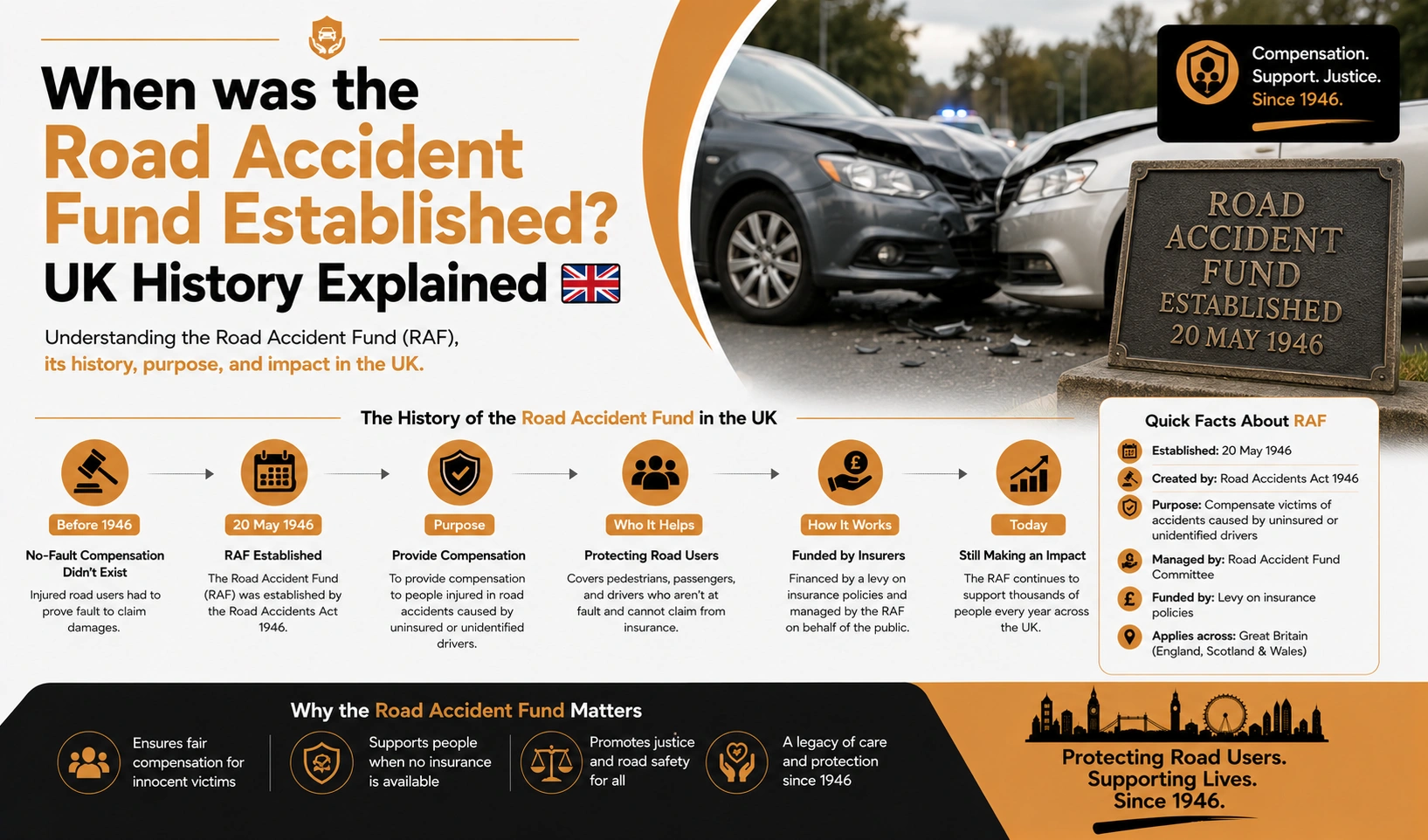
The road accident fund establishment date was 1946, when the Motor Insurers’ Bureau (MIB) was founded to help victims of uninsured and untraced drivers. Before this, crash victims couldn’t find any way to get compensation if the driver didn’t have insurance or disappeared. This guide covers the history of road accident fund, including why it was created, how it has evolved, who it helps, and how it is funded. You will learn the key milestones from 1946 to today, including the Untraced Drivers Agreement and the Road Traffic Act. Let’s go through it.
The Road Accident Fund is not a government fund. It is run by the Motor Insurers’ Bureau, or MIB for short. The MIB pays compensation to people injured by uninsured or untraced drivers. For a simple road accident fund explained answer: it is a safety net for innocent victims.
The fund covers personal injury only. It does not cover vehicle damage. That is a common misunderstanding.
The road accident fund establishment date was 1946. That year, the Motor Insurers’ Bureau was officially founded. Before 1946, victims of uninsured drivers had no way to claim compensation. The only option was to sue the driver directly, which was often pointless because uninsured drivers rarely had money to pay.
The government and insurance industry saw the problem and agreed on a solution. The history of road accident fund starts with this simple idea: innocent victims should not pay for someone else’s failure to insure their car. The MIB was created to fill that gap.
The first Untraced Drivers Agreement was signed in 1946, the same year the MIB was founded. This agreement covered victims hit by drivers who could not be identified. Hit and run accidents finally had a compensation route.
This was the Road Accident Fund UK launch. It was a landmark moment for UK road safety and victim rights.
| Year | Change |
| 1946 | MIB founded, first Untraced Drivers Agreement. |
| 1969 | First agreement for uninsured drivers introduced. |
| 1988 | Road Traffic Act made MIB obligations law. |
| 1999 | Compensation limits increased. |
| 2015 | New Untraced Drivers Agreement introduced. |
| 2021 | Whiplash reforms affected small claims. |
The MIB role in UK compensation has grown significantly since 1946. Each new agreement expanded who could claim and how much they could receive.
The fund helps three main groups of people. First, victims of uninsured drivers. Second, victims of untraced drivers (hit-and-run cases where the driver is never found). Third, passengers injured in a car that has no insurance.
The uninsured driver compensation origin dates back to 1969, when the first agreement for uninsured drivers was introduced. Before that, it only used to cover the untraced drivers.
Every insured driver pays a small levy in their annual premium. The government sets the levy amount, and insurers collect it. The money goes directly to the MIB to pay claims.
No victim pays anything to claim. The MIB role in UK compensation is funded entirely by law-abiding drivers through their insurance policies.
The MIB still runs the same scheme, now updated for modern roads and laws. In recent years, the MIB has paid over £300 million in compensation annually. It handles thousands of claims every year.
The road accident fund purpose remains unchanged since 1946: to protect innocent victims when the at-fault driver has no insurance or cannot be found.
The road accident fund establishment date was 1946, but the fund’s true value is measured in the lives it has protected. The MIB has paid billions to innocent crash victims since then. That is millions of people who would have received nothing without this safety net. The history of road accident fund shows that drivers help drivers, even the ones they will never meet. That is why the Road Accident Fund still matters today.
The road accident fund establishment date was 1946. The Motor Insurers’ Bureau (MIB) was founded that year. It was created to help victims of uninsured and untraced drivers.
The MIB is the institute that manages the Road Accident Fund. It pays compensation to people injured by uninsured or untraced drivers. The MIB establishment date was 1946.
Every insured driver pays a small levy in their annual premium. The government sets the amount. The history of road accident fund shows it has always been funded this way.
It covers personal injury only. It does not include any compensation for vehicle damage. For a simple road accident fund explained answer: it pays for injuries, not car repairs.
Victims of uninsured drivers can claim compensation. Victims of untraced drivers (hit and run) can also claim. The uninsured driver compensation origin started in 1969 for passengers injured in uninsured cars.
The MIB pays over £300 million each year in compensation. This money goes to thousands of innocent crash victims annually. The MIB role in UK compensation has grown significantly since 1946.
It is an agreement through which victims of hit-and-run drivers can file for compensation. The driver is never found, but the victim still gets paid. The first untraced drivers agreement history dates back to 1946.
Yes, the Road Accident Fund is run by the MIB. UK drivers use these terms interchangeably. The road accident fund purpose is the same as the MIB’s purpose.
No, before 1946, there was no compensation for victims of uninsured drivers. The only option was to sue the driver directly, which rarely worked. The road accident fund UK launch in 1946 changed that.
The fund started with only untraced driver cover in 1946. Uninsured driver coverage was added in 1969. The MIB role in UK compensation has expanded through several agreements since then.
A non-fault accident car hire UK service gives you a replacement car

A non-fault accident car hire UK service gives you a replacement car

A non-fault accident car hire UK service gives you a replacement car

A non-fault accident car hire UK service gives you a replacement car

A non-fault accident car hire UK service gives you a replacement car
A non-fault accident car hire UK service gives you a replacement car