
Vulnerable Road Users (VRUs): Rights, Safety, and Legal Protection
A non-fault accident car hire UK service gives you a replacement car
Home » Automotive Blog » Constructive Total Loss: What It Means and How It Affects Your Claim
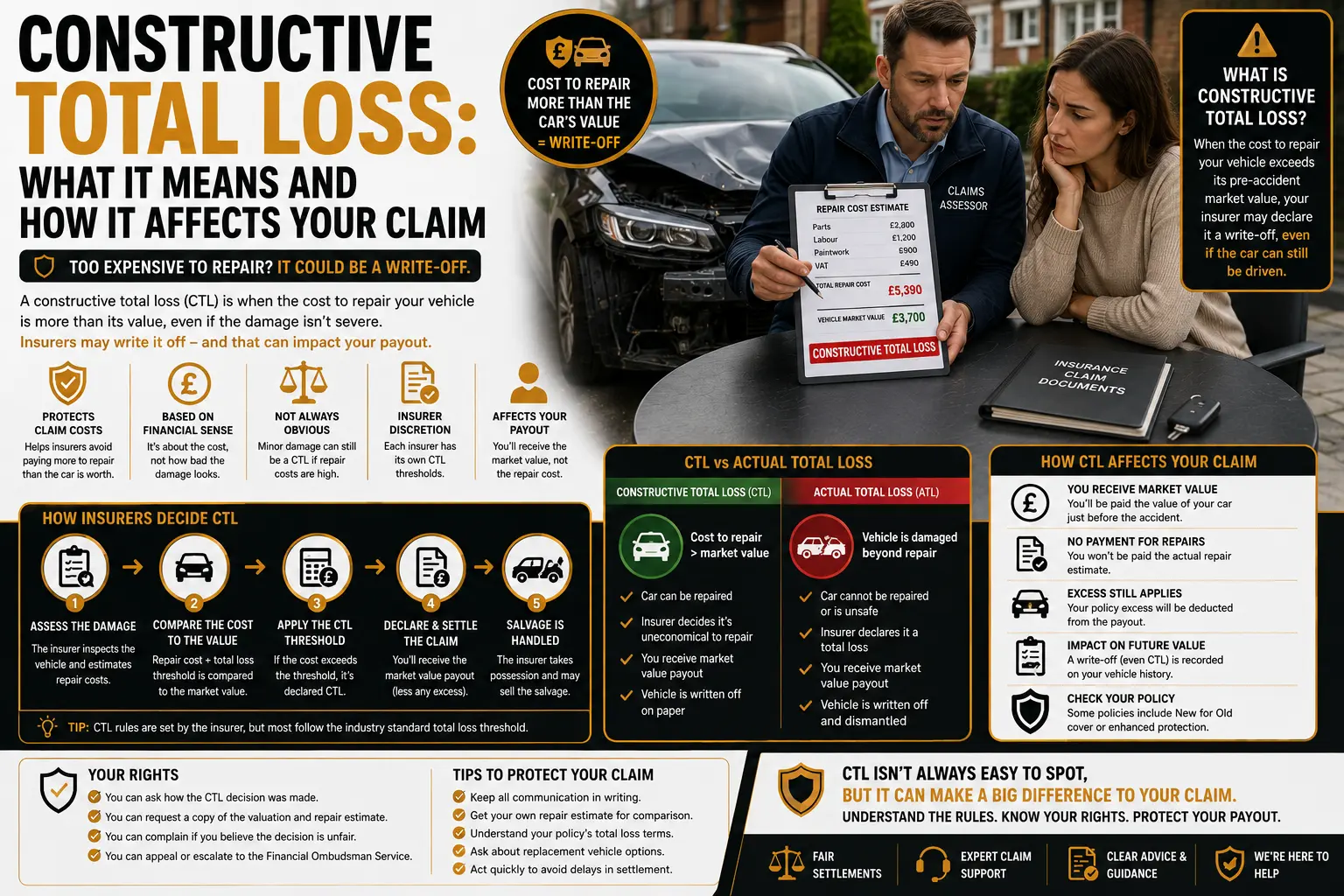
A constructive total loss means your car can be repaired. Yet the full repair route costs too much. The insurer may deem it an economic total loss and offer a total-loss settlement instead.
That offer begins with the pre-accident vehicle value. Your excess, finance, and car salvage value can reduce the amount you receive. Categories S and N show whether repairs are allowed.
You may keep a written-off car in some cases. You can also challenge insurer valuation evidence when an offer seems low. This guide explains every stage in plain English.
A car does not need to be beyond repair. It may still become a constructive total loss. The main reason is cost.
For example, your car may be worth £7,000. The repair quote may reach £6,500. Other claim costs may push the total even higher.
These costs may include:
The insurer looks at the full claim cost. It does not only check visible damage. A repair may become too risky or costly.
UK guidance defines this as a repairable car whose repair cost exceeds its replacement value.
Modern cars can cost a lot to fix. A small crash may damage several hidden parts. One broken light may also contain costly sensors.
| Cost | Why It Matters |
|---|---|
| Parts | Replacement parts can significantly increase the overall repair cost. |
| Labour | Complex or lengthy repairs can substantially increase labour charges. |
| Recovery | A damaged vehicle may need to be transported to a repairer or storage facility. |
| Storage | Daily storage charges can increase while the claim or repair is being assessed. |
| Hidden Faults | Additional damage may only become visible once the vehicle is inspected or dismantled. |
| Car Hire | Longer repair periods can increase replacement vehicle or hire costs. |
| Salvage | The damaged vehicle may retain a salvage value that affects the overall claim calculation. |
There is no fixed write-off rate for every claim. Each insurer reviews the full cost. The vehicle’s age and value also matter.
The same crash may produce two results. A newer car may still be repaired. An older car may become a repairable write-off.
The ABI says added costs can make repairs uneconomic. Replacement transport is one possible example.
The category shows what happens to the car. It also shows whether it can return. There are four main categories.
Category S and N cars may return to the road. They need safe repairs first. Categories A and B cannot return.
Category N does not always mean light damage. The car may have costly brake or wiring faults. Steering and safety systems may also be affected.
A repairable write-off will normally fall into Category S or N. An actual loss will fall into Category A or B.
A total loss settlement starts with market value. This is what the car was worth before the crash. It is not always the price you paid.
The insurer may check:
This starting figure is the pre-accident vehicle value. It should reflect a car like yours. Wrong details may lead to a low offer.
The insurer may then make deductions. Your policy excess may come off first. Salvage or finance may also affect payment.
The Financial Ombudsman says insurers usually pay the market value from just before the loss.
The first offer should be fair. The FCA says it should be the insurer’s best estimate. Insurers should not begin with a low figure.
You may keep a written-off car when it is Category S or N. Tell the insurer before accepting payment. Ask for the category in writing.
The insurer will set the car salvage value. This is the damaged car’s current worth. That amount will reduce your payout.
Before keeping it:
A repaired car may sell for less later. Some insurers may also charge more. Check these costs before you agree.
GOV.UK confirms that owners may retain Category S and N vehicles. Category S owners must also follow the correct V5C process.
The insurer values the car, not your loan. Its payment may go to the lender first. The amount may not clear your balance.
Here is a simple example:
You may still owe the £3,000 gap. GAP insurance may help in some cases. This depends on your policy terms.
Ask your lender for a fresh balance. Compare it with the insurer’s offer. Do this before accepting the claim.
The ABI warns that a market-value payout may be lower than the finance still owed.
You can accept the write-off decision but reject the price. You may also question the repair quote. Ask for clear proof behind both.
Use these steps:
Use adverts for cars like yours. Make the match with the age, mileage, trim, and condition. Poor matches may weaken your case.
This evidence may help you challenge insurer valuation figures. Keep all reports, adverts, and emails. Save finance records as well.
After a non-fault crash, Continental Car Hire can explain possible vehicle hire options. Any service will depend on the claim and hire terms.
A constructive total loss does not mean repair is impossible. It means fixing the car no longer makes financial sense. The insurer may choose a cash payout instead.
Check the value, excess, finance, category, and salvage. Ask how each figure was reached. Do not accept an offer you do not understand.
The car can still be repaired. Yet the repair route costs too much. The insurer may pay its earlier value instead.
Yes, it is still an insurance write-off. The choice is mainly based on cost. The car may still be safe to repair.
Category S and N cars may return. They need safe repairs first. The car must also be roadworthy.
The insurer checks the full claim cost. This may include repairs, storage, and hire. Hidden damage may raise the total.
It may be Category S or N. Category S means structural damage. Category N means no structural damage.
It starts with the car’s market value. Valid deductions may then be made. These may include excess and salvage.
You may keep some Category S or N cars. Tell the insurer before accepting payment. The salvage amount will reduce your claim.
The insurer may pay the lender first. The payment may not clear the balance. GAP cover may help under its terms.
Yes, ask how the value was set. Use close car adverts as proof. Complain if the offer remains too low.
It may reduce the car’s future value. Some buyers avoid earlier write-offs. Clear repair records may help.
A non-fault accident car hire UK service gives you a replacement car
A non-fault accident car hire UK service gives you a replacement car

A non-fault accident car hire UK service gives you a replacement car

A non-fault accident car hire UK service gives you a replacement car
A non-fault accident car hire UK service gives you a replacement car

A non-fault accident car hire UK service gives you a replacement car