Non-Fault Claims: Your Rights After a Car Accident
A non-fault accident car hire UK service gives you a replacement car

Home » Automotive Blog » Admission of Liability: Why You Should Never Admit Fault at the Scene
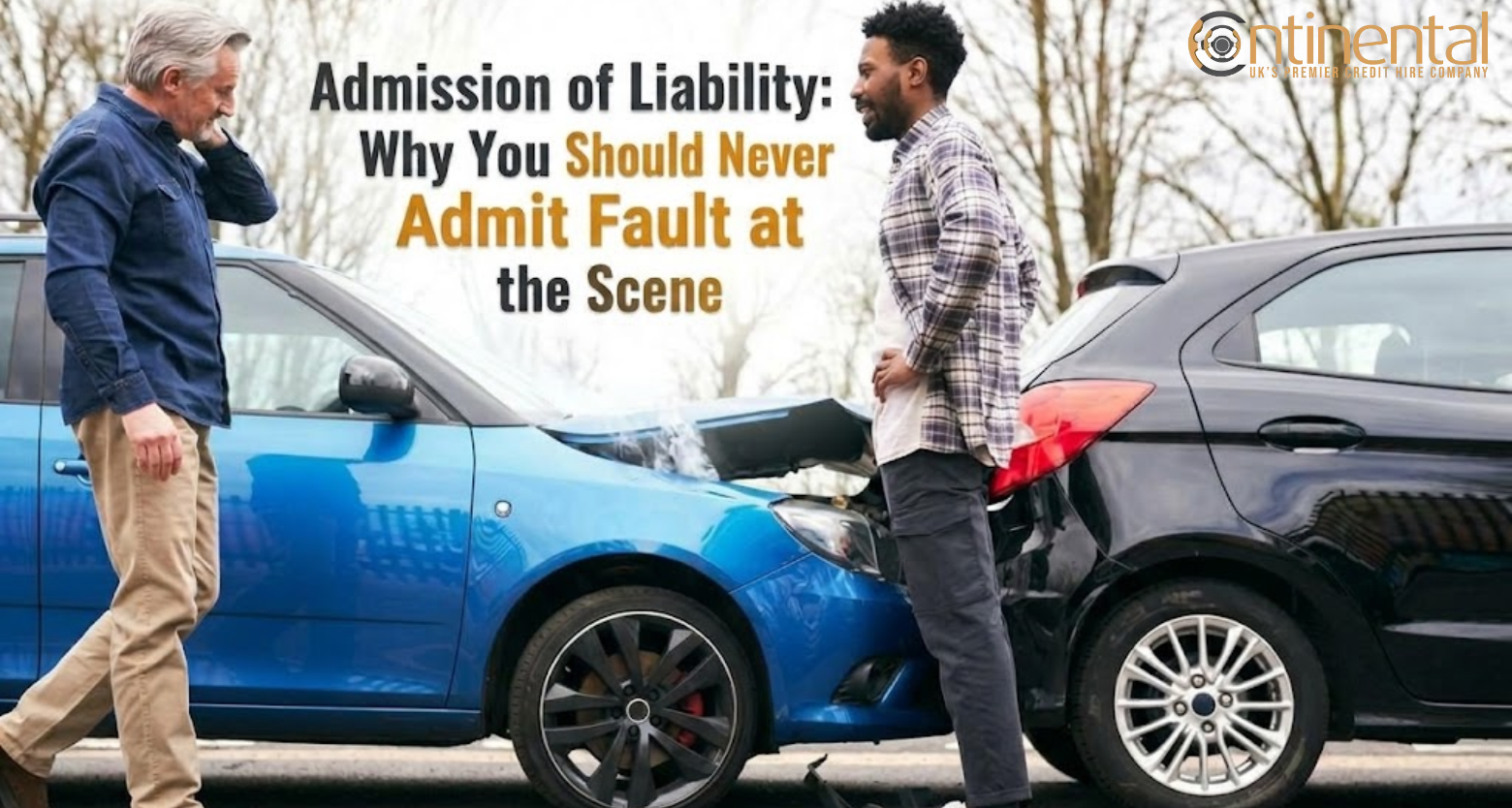
Admitting fault at the scene creates an admissible hearsay record that can accidentally break your insurer’s rules, giving them an excuse to reject your claim entirely. It can also legally stop you from recovering compensation for vehicle damage, injuries, or hidden external factors like mechanical failures and municipal road defects.
Therefore, focus on safety, exchange the required details and record what happened without deciding who was legally responsible. This guide explains what an admission of liability means, why drivers make admissions, what you should say instead, how evidence can affect a dispute and what to do if you have already accepted blame.
After a collision, keep your conversation factual. You can be polite and helpful without deciding who was legally responsible.
For example, you can say:
Give the facts and do not make assumptions. Most importantly, do not guess. If you did not see something, say that you did not see it. This is more useful than making a definite statement based on assumptions.
The same principle applies when speaking to police officers, insurers or witnesses: describe the events accurately and let the appropriate process establish responsibility.
Saying “sorry” after a collision does not automatically mean you have legally admitted liability, because the meaning depends on the words used and the circumstances. However, avoid making statements that clearly accept blame.
An apology is often an instinctive response after an accident. You may be concerned about the other person or simply reacting to the shock of the collision.
However, there is a clear difference between:
“I’m sorry this happened.”(An expression of empathy)
and:
“I accept that I caused the accident.” (A clear admission of blame)
The second statement is much more direct and could become relevant if responsibility is later disputed. Therefore, keep your comments factual and avoid deciding liability at the scene.
You can show concern without accepting legal responsibility.
Good evidence can become particularly important when both drivers give different accounts. Therefore, preserve anything that can help establish the position, movement and circumstances of the vehicles.
If it is safe, collect:
Avoid taking pictures if the surroundings are not safe. The Highway Code’s collision guidance requires drivers to stop in a place of relative safety where possible.
Keep original dashcam files rather than relying on edited clips. If your camera uses a memory card that continuously records, copy the relevant footage before it is overwritten.
Similarly, keep original photographs and documents. These records can help your insurer understand the accident if the other driver’s account later differs from yours.
The more accurately the evidence records what happened, the less reliance there may be on conflicting memories.
A few simple mistakes can make a later dispute harder to deal with. Therefore, concentrate on preserving evidence and communicating carefully.
Avoid:
You should also avoid contacting the other driver repeatedly to discuss who was responsible. Once the immediate exchange of information is complete, further discussions can create unnecessary confusion.
Your priority is to preserve the facts, not to win an argument at the scene.
The other driver’s admission can help, but you should not rely on it alone. Their insurer may later dispute the circumstances or challenge the extent of their responsibility.
For that reason, preserve independent evidence even when the other driver says the accident was their fault.
Take photographs when safe, save dashcam footage and obtain witness details. Also, make a note of what was said while the conversation is still fresh in your memory.
The Highway Code requires drivers involved in collisions causing damage or injury to stop and provide specified details. It does not require drivers to decide liability at the roadside.
Dashcam footage can show the events immediately before and during a collision. Depending on the vehicle and system, telematics data may also provide information about speed, braking or vehicle movements.
Save relevant recordings promptly because some systems automatically overwrite older footage.
An admission can support your account, but independent evidence can provide a much clearer picture of the accident.
An admission of liability means accepting legal responsibility for an accident and the loss or injury caused by it. However, not every comment made after a collision is automatically a formal admission.
The distinction matters because the circumstances of an accident may be more complicated than they first appear. Under the current RTA Small Claims Protocol, a compensator can admit liability in full, admit it in part, deny liability, or admit fault while disputing whether the accident caused the claimed injury.
A full admission means the compensator accepts that the accident happened, accepts fault in full and accepts that the claimant suffered some loss or injury caused by the accident. It does not necessarily mean that the type or amount of the loss has been agreed.
Therefore, accepting responsibility for causing an accident does not automatically settle the value of every resulting claim.
A partial admission means responsibility is accepted only to a certain extent. For example, the compensator may accept that their driver was partly responsible while disputing the remaining percentage.
The RTA Small Claims Protocol allows the parties to challenge or make further proposals about the percentage of responsibility in certain circumstances.
There is also an important distinction between accepting fault and accepting that an accident caused an injury. A compensator can accept fault for an accident but dispute that the accident caused the claimant’s injury. This means liability for the collision and causation of an injury are not always the same issue.
A formal admission made within a claims process is different from something said casually at the roadside.
For example, saying “I accept full responsibility for the accident” is much clearer than saying “I’m sorry, I didn’t see you.” The exact words, context and circumstances can matter, so drivers should avoid making conclusions about legal responsibility before the facts are established.
Fault, liability and causation are often used together after a road accident, but they describe different parts of the dispute. Understanding the difference helps you avoid making a statement before all the facts are known.
Term | Simple meaning |
Fault | The actions that caused the accident |
Liability | Legal responsibility for the claim or resulting loss |
Causation | Whether the accident caused the injury or loss being claimed |
For example, a driver might accept that they made a mistake but still dispute whether that mistake caused a particular injury. Similarly, an insurer may accept fault for the collision but dispute that the accident caused the injury being claimed. The RTA Small Claims Protocol expressly allows this distinction.
Therefore, saying “I made a mistake” is not necessarily the same as making a formal admission of liability. The exact wording and circumstances matter.
Most people do not intend to create a legal problem when speaking after a collision. Instead, stress, shock and incomplete information can lead to statements that are made before everyone understands what happened.
A collision can trigger an immediate stress response. Your attention may be focused on injuries, vehicle damage or the other people involved rather than on establishing exactly how the accident happened. Consequently, you may agree with something simply because you are overwhelmed at the time.
You may believe you caused the accident because you saw only part of what happened. However, another vehicle’s speed, position, movement or sudden manoeuvre may only become clear after reviewing the evidence.
You do not have to decide liability at the roadside.
The other driver may insist that you caused the collision or ask you to accept blame. Even if the conversation becomes uncomfortable, remain calm and stick to what you know. You can exchange the required details and cooperate without making a legal admission.
Police involvement does not automatically settle every question about civil liability. Officers may investigate a possible traffic offence, while insurers and courts can separately consider responsibility for damage or injury.
A driver may receive enforcement action for a traffic offence. However, that does not necessarily determine every issue involved in an insurance or personal injury claim.
Equally, receiving no penalty does not automatically prove that a driver was not responsible for the collision.
The Highway Code explains that its rules can be used as evidence in court proceedings to help establish liability. However, the impact of the rule depends on the case.
Regardless of who you believe caused the accident, certain duties still apply. For example, Highway Code Rule 286 states that drivers involved in a collision causing damage or injury must stop and provide specified details to people with reasonable grounds for requesting them.
If you do not provide your name and address at the scene, the rule requires you to report the collision to the police as soon as reasonably practicable and, in any event, within 24 hours.
Therefore, do not confuse cooperating with the police with admitting fault. You can fulfil your legal duties while leaving responsibility to be assessed from the facts.
If you have already admitted fault, do not assume the claim is ended. Instead, record exactly what you said and preserve the evidence surrounding the collision.
Your next steps should be straightforward:
This is especially important because a casual roadside statement and a formal admission within a claims process are not necessarily treated in the same way.
Yes. Admitting fault at the scene does not automatically mean that you have lost your right to make a claim. A casual statement made immediately after a collision is not treated the same as a formal admission made within a legal claims process.
The ultimate outcome depends on the exact wording, the context of the scene, and whether independent evidence proves the other driver was actually responsible. Tell your insurer what happened accurately and avoid changing your core account simply because you are worried about the consequences of your roadside words.
An admission cannot simply be treated as cancelled because you later regret making it. The position depends on what admission was made, when it was made and whether the claim has entered formal proceedings.
Under CPR Part 14, different rules apply to admissions made before and after court proceedings begin. Certain admissions can be withdrawn in specific circumstances, while court permission may be required in other situations.
The RTA Small Claims Protocol also contains specific provisions for withdrawing certain admissions, including admissions concerning causation.
Therefore, if you believe an admission was made incorrectly, do not simply send another message saying that you withdraw it. First establish exactly what was admitted and obtain appropriate advice where necessary.
An admission of liability removes disputes about who caused the crash, but it does not automatically settle the claim, guarantee compensation, or establish a final payout figure. Under the Official Injury Claim (OIC) and RTA Small Claims Protocols, liability and compensation remain entirely separate issues.
Even if the other driver’s insurer admits fault in full, they may still dispute whether the accident directly caused your specific medical issues. For personal injury claims, particularly whiplash, the rules strictly dictate that you must obtain an independent medical report before the whiplash element can be valued or settled.
You must separately prove any financial losses by supplying documented receipts or invoices for travel expenses, treatment costs, vehicle damage, policy excesses, or loss of earnings. Once this evidence is reviewed, the compensator can make a formal valuation settlement offer. If values are agreed, it closes; if they remain disputed, the claim proceeds toward a court determination.
Once a full or partial liability admission is secured, you can request an interim payment under the protocol to cover immediate, eligible accident expenses (such as travel or property damage). It is not an advance on your core injury compensation. The compensator must legally respond to an interim request within 15 days, or you retain the option to elevate the issue to court.
There is no single timeframe that applies to every road accident claim because the process depends on the type of claim, the evidence available, and whether responsibility is disputed.
Under the Official Injury Claim (OIC) portal, strict statutory windows apply:
A liability dispute means the parties do not agree about who was responsible for the accident or what percentage of responsibility should be accepted.
The RTA Small Claims Protocol provides for full admissions, partial admissions, denial of liability and situations where fault is admitted but causation of an injury is disputed. Where liability is admitted only in part, the parties can make proposals about the percentage of responsibility.
Evidence then becomes particularly important. Insurers may consider driver accounts, witness statements, engineers’ reports and CCTV when assessing a motor insurance dispute.
If the accounts differ, provide all relevant evidence rather than relying on one statement.
This may include:
If the matter cannot be resolved through the relevant claims process, court proceedings may ultimately be required. The RTA Small Claims Protocol is designed to allow evidence to be exchanged and, where necessary, used in court proceedings.
The key is to establish what happened from the available evidence rather than allowing a rushed roadside comment to become the whole story.
A partial admission means the compensator accepts responsibility for only a percentage of the accident. For example, it may argue that its driver was 70% responsible rather than accepting full responsibility.
Under the RTA Small Claims Protocol, the claimant can accept the percentage offered or challenge the partial admission through the applicable process. The parties may make further proposals about the percentage of responsibility, subject to the rules of the Protocol.
If a percentage of liability is ultimately accepted, the agreed proportion can affect the amount payable under the claim. The Protocol states that settlement and interim payments must take the agreed percentage of liability into account.
This is why a partial admission should not be treated as though the insurer has accepted the whole claim.
The phrase “without admission of liability” generally means that a person or organisation is communicating or making an offer without accepting legal responsibility for the underlying claim.
It is different from an admission of liability. An admission accepts responsibility to the extent stated, whereas a communication made without admission of liability does not, by itself, establish that responsibility has been accepted.
The exact effect depends on the wording, circumstances and legal context. Therefore, do not assume that every payment, offer or settlement discussion means that liability has been admitted.
Admitting fault at the scene can create unnecessary difficulties because you may not yet know the full circumstances of the accident. Therefore, stay calm, exchange the required details and describe only what you know. Preserve dashcam footage, photographs and witness information, then report the accident to your insurer as required. If you have already made an admission, do not assume the matter is automatically settled. Review what was said and seek appropriate advice if liability becomes disputed. For drivers who need transport after a non-fault accident, Continental Car Hire can provide further support.
No, saying “sorry” is an expression of empathy, not a legal admission of fault, though you should strictly avoid adding statements that explicitly accept blame.
The OIC is a free government portal that you must use if you are an adult injured in England or Wales and your personal injury claim is worth £5,000 or less.
Yes, but only under specific legal criteria set out in Civil Procedure Rules (CPR) Part 14 and protocol guidelines, usually requiring formal court permission.
It means an insurer is offering a settlement or communicating with you without legally accepting blame for the accident.
No, police tickets only address traffic offences, whereas civil car insurance fault is determined separately by evaluating all available evidence.
Yes, a casual roadside remark does not forfeit your rights if independent evidence (like dashcam footage or witness statements) proves the other driver was actually at fault.
Yes, you can add emerging injuries later when uploading your independent medical report, but changing your core story later looks suspicious to insurers.
The best evidence includes raw dashcam footage, scene photographs, witness contact details, telematics data, CCTV, and police reference numbers.
Yes, insurers have the contractual right to settle or accept fault based on their evidence assessment, though you can formally dispute their decision.
The portal will ask you to upload your evidence, and if neither side backs down, you can take the dispute out of the portal to a small claims judge.
Review what was said and seek appropriate advice if liability becomes disputed. Dealing with insurance claims and liability disputes is stressful enough without losing your independence on the road. If you have been involved in an accident that wasn’t your fault, you can hand the logistical burden over to the professionals. Continental Car Hire, a Trusted Replacement Vehicle Provider, can provide further support, helping eligible drivers arrange suitable replacement vehicles
With 22+ years of experience and a fleet of 200+ vehicles, the team supports drivers with accident-related mobility needs. A free consultation is available, and assistance may be possible within around 90 minutes, subject to eligibility, location and vehicle availability. Where applicable, replacement vehicle support can be provided without upfront hire costs. For accident support, call +44 208 743 7469.
A non-fault accident car hire UK service gives you a replacement car
A non-fault accident car hire UK service gives you a replacement car

A non-fault accident car hire UK service gives you a replacement car
A non-fault accident car hire UK service gives you a replacement car
A non-fault accident car hire UK service gives you a replacement car
A non-fault accident car hire UK service gives you a replacement car
Copyright © 2026 Continental Car Hire Ltd. All Rights Reserved.
Continental Car Hire Ltd is authorised and regulated by the Financial Conduct authority (FRN 711301)